Soap making tutorials
The ancient art of soap making:
The ancient art of soap making is an alchemical craft with roots in ancient civilizations, where people discovered that mixing fats or oils with an alkali created a cleansing substance. While originally used for cleaning textiles and medicinal purposes, the craft evolved over millennia into a refined product for personal hygiene.
The origins of soap making:
- Ancient Babylon (~2800 BCE): The earliest recorded evidence of soap making comes from clay cylinders discovered in ancient Babylon. These artifacts contain inscriptions detailing a primitive soap recipe made by boiling fats with ashes. This substance was likely used for cleaning wool and cotton before weaving.
- Ancient Egypt (~1550 BCE): The Ebers Papyrus, an ancient Egyptian medical text, mentions a soap-like material made from animal or vegetable oils and alkaline salts. Egyptians used this for washing and treating skin diseases.
- Ancient Rome (1st Century AD): The word “soap” is said to derive from Mount Sapo, where, according to Roman legend, rainwater mixed with animal fat and wood ash from religious sacrifices would flow into the Tiber River. This mixture created a sudsy clay that made washing clothes easier for women. While the Romans developed public baths, many initially used oils for cleansing and scraped them off with a tool called a strigil. By the 2nd century AD, the Greek physician Galen documented soap made from lye and prescribed it for medicinal purposes.
The evolution and spread of the craft:
- The Islamic Golden Age (8th–13th centuries): Soap making developed into a major industry in the Middle East, particularly in cities like Nablus, Damascus, and Aleppo. Recipes from this period describe the process using vegetable oils, such as olive oil, with alkali and lime to produce a hard, pleasant-smelling soap. This fragrant soap was exported across the Muslim world and to Europe.
- Medieval and Renaissance Europe: The knowledge of soap making returned to Europe, with major production centres emerging in Italy, Spain, and France, areas with access to olive oil. Notable examples include Castile soap from Spain and Marseille soap from France. This time saw the creation of soap-maker guilds that guarded their recipes and perfected the craft. However, for centuries, high taxes and ingredients made soap a luxury item for the wealthy.
- The American Colonial Era: Colonial housewives saved cooking grease and wood ash throughout the year to make soft or liquid soap for laundry. The laborious task was often a spring or fall chore.
Saponification: The ancient method:
The core of ancient soap making was the process of saponification, a chemical reaction between fats (triglycerides) and an alkali. While the modern version is more precise, the principle remains the same.
- Rendering the fat: Tallow (animal fat) or vegetable oil was boiled to purify it.
- Creating the alkali (lye): Water was filtered through wood ashes to create a caustic lye solution. This was a challenging process, as the lye’s strength could be inconsistent.
- Boiling and stirring: The fat and the lye solution were boiled together in a large kettle and stirred constantly until the mixture thickened.
- Salting out: Sometimes, salt was added to separate the soap from the glycerine, causing the soap to rise to the top.
- Curing: The resulting mixture was poured into moulds to cool and harden over several weeks. A longer cure time produced a harder, longer-lasting bar.
Now we come to the more modern art of soap making with the publications illustrated below. Just click on the description or the image to download the PDF file totally for free:
| Soap making guide of 16 pages:
|
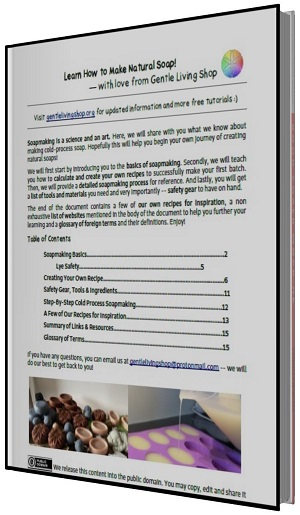
Learn How to Make Natural Soap of 15 pages:
|
|
Soap making e-book of 18 pages:
|
The Complete Guide to Natural Soap Making of 109 pages:
|
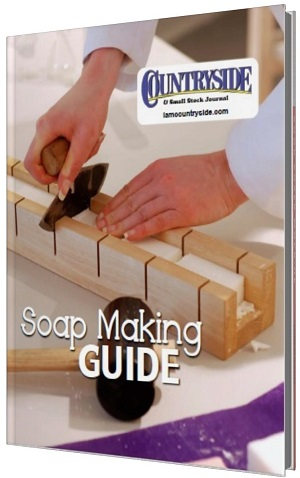
The Natural Soap Making eBook for Beginners of 147 pages:
Enroll for an online course here: https://lovinsoap.com/freebies/ . Also get their free e-book publication(s).
You can start your own soap making business. It is just a question of on what scale to start it with.
Plus the following 4 PDF publications:
| Candle making 1 e-book of 13 pages:
|
Candle making 2 e-book of 20 pages:
|
| How to make your own perfume of 28 pages:
|
The chemistry of fragrances of 297 pages:
|
How to scale up any business venture can be seen on this page: